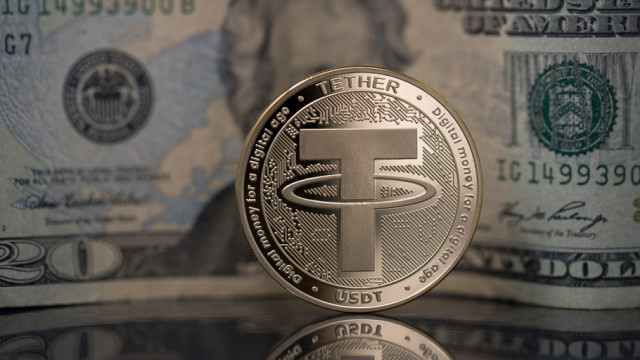
The $20 million risk to USDT and USDC stablecoins on PulseChain
More than $20 million in USDT and USDC stablecoins on PulseChain are in the balance, vulnerable to potential blockades by their respective issuers, Tether and Circle.
Keep up with what's happening in the crypto world in real-time.
More than $20 million in USDT and USDC stablecoins on PulseChain are in the balance, vulnerable to potential blockades by their respective issuers, Tether and Circle.
Crypto exchange Binance has issued a recommendation for customers using the services of Paysafe for euro (EUR) transfers. The crypto trading platform is advising users to convert their euro balances to tether (USDT) or withdraw them to bank accounts after the payment processor suspended deposits and withdrawals in the common European currency.
Binance (CRYPTO: BUSD) is looking to replace Paysafe (NYSE: PSFE) as its banking partner. What Happened: The crypto exchange has notified all Paysafe users to convert their EUR balances into Tether (CRYPTO: USDT) by Oct. 31.
In the realm of stablecoins, USDT has experienced a noteworthy surge in trading volume, shaped by a multitude of pivotal factors.
Spurred on by user requests, traditional Bitcoin lending firm Ledn is rolling out an Ethereum yield product.
Following Paysafe's unilateral split from Binance, users are advised to move their euro balances to Tether's USDT.
In the latest development surrounding Binance's European operations, the cryptocurrency exchange has issued a call to action for its regional users. Binance is urging European users with euro balances to convert their holdings into Tether (USDT) before the end of October.
Cryptocurrency exchange Binance advised its users to convert their fiat Euro balances into Tether's USDT before the end of October after it lost the support of its banking partner, Paysafe. In a Sept.
Binance urges European users to convert Euros to Tether (USDT) following the disruption caused by Paysafe's decision to stop processing EUR deposits for Binance accounts.
Binance's European debanking woes continue as it urges Paysafe users to convert their Euros to digital dollars.
With a new ecosystem platform, Tether and its ecosystem's companies will be able to control and manage Bitcoin (BTC) mining in a more resource-efficient manner. The product will support various classes of mining software and will be secured by a multisignature module.
Elliptic has disclosed that cyber-criminals responsible for the Mixin Network hack currently control more than 90% of the project's USDT holdings
The evolving economic landscape and sentiment shifts may challenge the optimism around cryptos, prompting a risk reassessment.
Tether has communicated to Cake DeFi that since the latter is controlled by “another corporation that resides in Singapore,” it is precluded from redeeming USDT.
Unexpected alterations to Tether's terms of service in Singapore shutting USDT redemptions has left Cake DeFi and others in suspense.
In a recent turn of events within the crypto sphere, Tether, the prominent cryptocurrency stablecoin issuer, found itself embroiled in a controversy that raised concerns among Singaporean crypto enthusiasts. The uproar began when Dr. Julian Hosp, CEO of Cake DeFi, took to social media to share an email from Tether indicating changes in their onboarding standards, specifically impacting Singapore-based entities.
Tether, the company behind the widely-used stablecoin USDT, has clarified its position on its terms of service for Singapore-based entities. The clarification comes after Dr. Julian Hosp, CEO of Cake DeFi, a decentralized finance platform, raised concerns about Tether's onboarding standards in the city-state.
The CEO of Cake DeFi, Julian Hosp, shared an email from Tether explaining this policy change. There's speculation that this change may be connected to a recent money laundering case in Singapore.
A controversy surrounding Alex Welch, an alleged spokeswoman of Tether, the company behind USDT, erupted last week as an article in the Wall Street Journal (WSJ) quoted her as a source for information on the company's loans.
Popular stablecoin provider, Tether, has unveiled modifications to its service terms in Singapore, potentially affecting a wide range of its clientele, including the DeFi company, Cake DeFi. Julian Hosp, the CEO of Cake DeFi, disseminated an email he obtained from Tether.
In a recent communication, Tether made a surprising revelation, asserting that Cake DeFi's operational control rested in the hands of “another corporate entity, located in the vibrant city-state of Singapore.
Tether Singapore prohibited affirmed by CTO Paolo Ardoino. He clarified its stance on restricting certain customer groups in specific jurisdictions.
Tether, a major player in stablecoins, has resumed lending USDT despite earlier promises to stop. This has raised worries in the crypto community about the risks tied to Tether's strong influence in the stablecoin market. Is Singapore becoming the next US in suppressing crypto freedom? Let's discuss the Tether FUD in Singapore.
Tether has addressed confusion over whether it has changed its terms of service (ToS) in Singapore. The company was responding to the CEO of Cake who claimed Tether was restricting its onboarding standards.